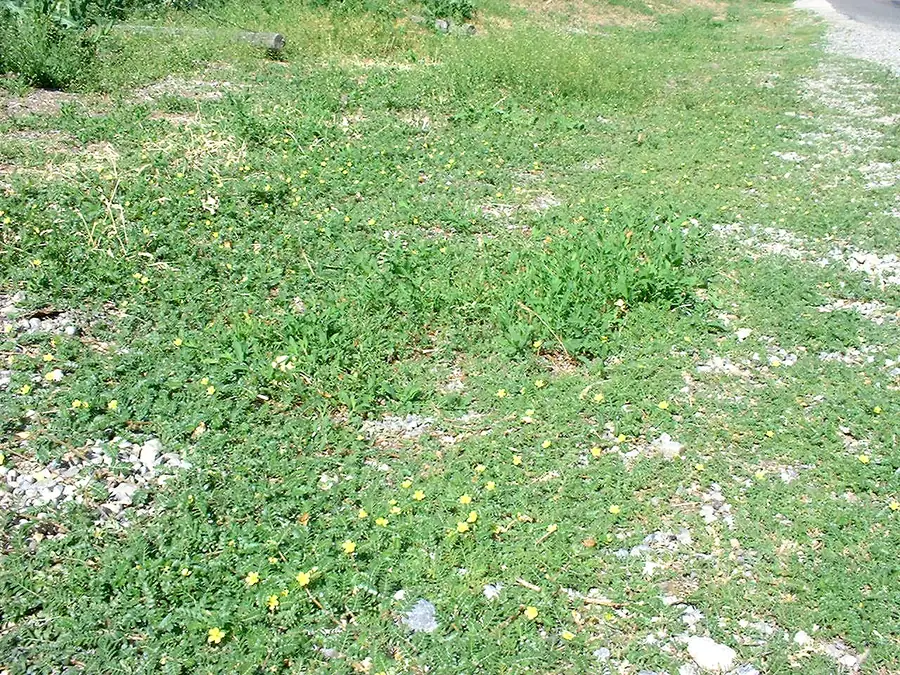
Puncturevine
Tribulus terrestris
Also known as Goathead
Plants widely distributed in Utah. The current populations of these plants should be contained to halt their spread. These plants should not enter commercial channels.
Background
Native to Eurasia and Africa puncturevine can be found along roadsides, in cropland, pastures, and waste areas. It tolerates very dry conditions and poor soil. Its spiny fruit can penetrate skin, bicycle tires, and thin vehicle tires, and cause external and internal injury to grazing animals. Puncturevine foliage can also be toxic to livestock.
Description
A mat-forming summer annual with a deep taproot. Leaves consist of four to eight pairs of oval-shaped leaflets. Stems and leaves are covered with tiny hairs. The plant blooms throughout the summer, producing single, bright yellow, five-petaled flowers. The fruit is spiny and resembles a five-rayed cross, which turns brown and woody as it matures. It then splits into five separate, wedge-shaped seedpods.
Control
Puncturevine plants can be controlled before fruit develops by digging, hoeing, tilling, and hand-pulling every few weeks throughout the season. Biocontrol may be available. Herbicides are also effective.