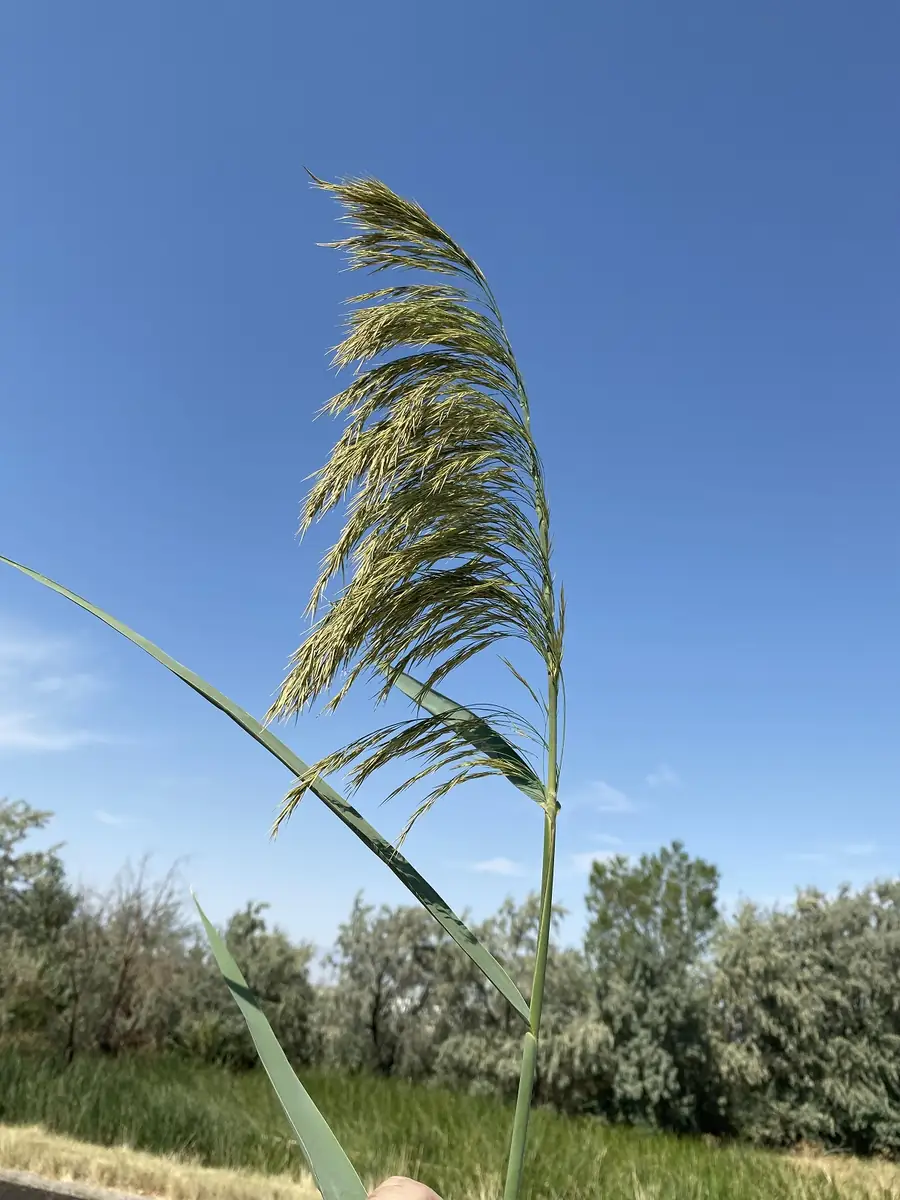
Phragmites
Phragmites australis
Also known as Common reed
Plants widely distributed in Utah. The current populations of these plants should be contained to halt their spread. These plants should not enter commercial channels.
Background
Native to North America and Europe, phragmites is a weed in wetlands, marshes, and waterways, where it can form impenetrable stands. It is sold by nurseries, is commonly used in erosion control, and sometimes for livestock grazing. It is tolerant of fire and salinity.
Description
A perennial rhizomatous grass, with hollow, sometimes creeping stems. Phragmites grow up to 10 feet tall, with rhizomes as deep as 3 feet, and rough-margined leaves up to 1 1/2 feet long. Flowers form in dense, brown, feathery plumes at stem tips. Phragmites is commonly mistaken for giant reed. However, the flower-bearing stems on giant reed are hairless, whereas those of phragmites have silky hairs.
Control
Do not plant phragmites. Because of extensive rhizomes, most mechanical control measures are only partially successful, and some actually encourage its spread. Research on biocontrol agents is ongoing. Systemic herbicides can be effective.